Lethal Spots, Vital Secrets: Medicine and Martial Arts in South India by Roman Sieler
Author:Roman Sieler [Sieler, Roman]
Language: eng
Format: azw3
Publisher: Oxford University Press
Published: 2015-06-01T00:00:00+00:00
Naming the Secret: Vital Spots and Biomedical Terminologies
Despite or, rather, because of such secretive behavior of ÄcÄá¹s, patients often seek ways to comprehend and label what they are afflicted with. This is exemplified by the case of a young man who approached Velayudhan because of an ailment, from which he had suffered for several years. Already having been unsuccessfully treated by a variety of practitioners and medical systems, he had decided to consult the ÄcÄá¹. The symptoms included a painful cough, and a constantly blocked nose, forcing him to breathe through his mouth, which he found very difficult. Velayudhan examined the patientâs pulse and eventually pronounced that this was indeed a varmam (ailment), and accordingly treatable. The patient, relieved, asked the name of his disease (nÅyiá¹ peyar). Shaking his head in negation, the ÄcÄá¹ answered that this simply was âvarmam.â Obviously unsatisfied with this, the young man, mistaking me for a biomedical professional,15 asked me to explain and name his disease, which, of course, I could not do. Velayudhan attempted to console the patient by describing that he had diagnosed excess kapa tÅcam, which aggravated phlegm (caḷi) inside his body, causing a deficiency of pirÄá¹am circulation. Apparently still not satisfied with this, the patient continued consulting me, asking whether, among other things, this was a âsinus problem.â
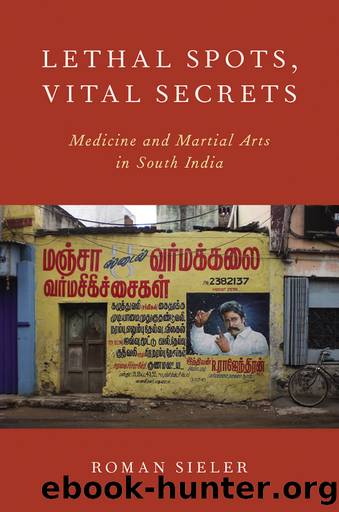
This case highlights several aspects: The youth with the mysterious respiratory problems attests to the fact that many patients turn to vital spot medicine as a last medical resort and in the case of chronic ailments, which biomedical treatment could not be cure. Nonetheless, the young man had not been content with the diagnosis of varmam, and reverted to lay biomedical categories rather than the one given by the ÄcÄá¹. It appears that some practitioners recognize this and either concede and cater to the needs of their patients, or promote their practices in biomedical terms. With regard to ayurveda, Naraindas (2006, 2662) has noted that often in urban India âefficaciousness, and the very premises of the dialogue, are framed by the language of biomedicine or some pidgin version of it.â There indisputably is an increasing deployment of biomedical terminology in order to address vital spot ailments and to promote related medical practices by ÄcÄá¹s. In particular, signboards of urban and semi-urban dispensaries depict lists of ailments treated by the practitioner. These often and increasingly include the nosological categories of biomedicine in addition to Tamil terms. The Tamil terms are often close or direct translations of biomedical diseases, such as: taá¹á¹upitukkam, literally âwheel protuberance,â which appears to describe disk prolapse; elumputÄyvu, âbone decay,â referring to spondylosis; elumpu tÄpitam, âbone heat,â paraphrasing spondylitis; taá¹á¹uvÄ«kkam, âwheel swelling,â as translation of disk bulging; and so on. This may evidence a practice of promoting vital spot therapies in idioms borrowed from biomedicine. This may also be an attempt to provide options of verbalized explanations of vital spot ailments and treatments. Such processes of naming the secret in biomedical terms then are possibly aimed at patients, who seek to find alternative explanations of varmam than âthat which is hidden.
Download
This site does not store any files on its server. We only index and link to content provided by other sites. Please contact the content providers to delete copyright contents if any and email us, we'll remove relevant links or contents immediately.
Periodization Training for Sports by Tudor Bompa(8240)
Bodyweight Strength Training by Jay Cardiello(7898)
Therapeutic Modalities for Musculoskeletal Injuries, 4E by Craig R. Denegar & Ethan Saliba & Susan Saliba(7708)
Born to Run: by Christopher McDougall(7115)
Imperfect by Sanjay Manjrekar(5860)
Wiseguy by Nicholas Pileggi(5757)
Shoe Dog by Phil Knight(5248)
Paper Towns by Green John(5168)
The Body: A Guide for Occupants by Bill Bryson(5067)
The Rules Do Not Apply by Ariel Levy(4946)
Tuesdays with Morrie by Mitch Albom(4760)
Endurance: Shackleton's Incredible Voyage by Alfred Lansing(4747)
Bodyweight Strength Training Anatomy by Bret Contreras(4659)
The Sports Rules Book by Human Kinetics(4374)
Yoga Anatomy by Kaminoff Leslie(4349)
Machine Learning at Scale with H2O by Gregory Keys | David Whiting(4284)
Dynamic Alignment Through Imagery by Eric Franklin(4201)
Science and Development of Muscle Hypertrophy by Brad Schoenfeld(4117)
Exercise Technique Manual for Resistance Training by National Strength & Conditioning Association(4051)
